Who guards the Pope, and why they are Swiss
The Pontifical Swiss Guard, explained
The Pontifical Swiss Guard has protected the Pope since 22 January 1506. It numbers 135 men, all Swiss Catholics, single when they join and aged between 19 and 30. New recruits are sworn in every 6 May, and you can see guards on duty for free at St Anne's Gate, the Bronze Door and the Arch of the Bells.
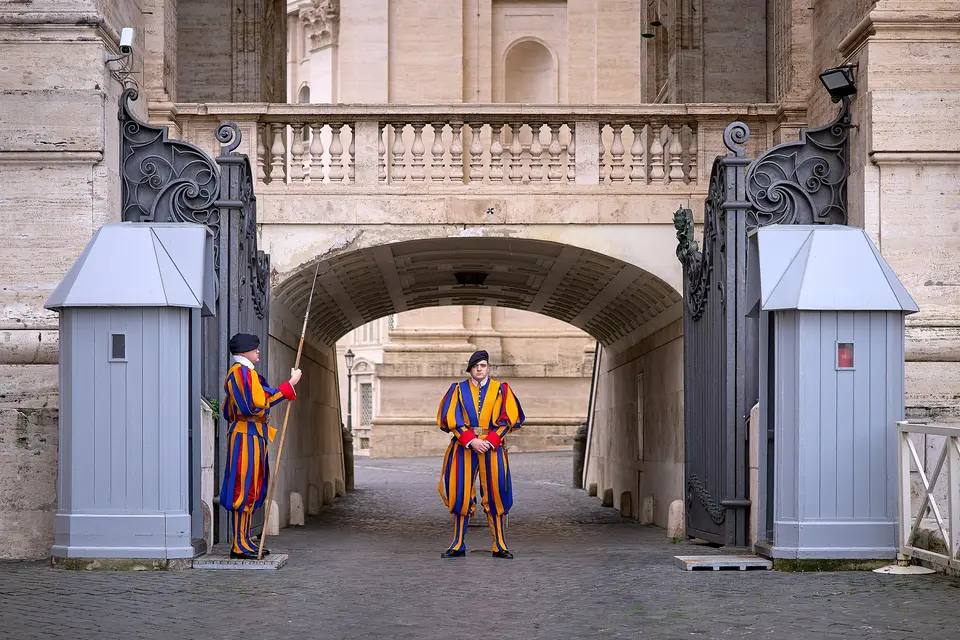
Most visitors meet the Swiss Guard the same way, standing stock-still beside a sentry box with a halberd and a striped uniform that looks borrowed from a Renaissance painting. It’s the photo everyone takes. The story behind it is better than the photo, and it answers the question British searchers ask most often, which is why a small state in the middle of Rome is guarded by soldiers from Switzerland.
Why Swiss soldiers guard the Pope
It goes back to one decision. On 22 January 1506, 150 Swiss soldiers led by Captain Kaspar von Silenen entered Rome in the pay of Pope Julius II, who blessed them on arrival. That date is still treated as the Guard’s founding day.
What turned a hired company into something closer to a family tradition happened 21 years later. On 6 May 1527, imperial troops stormed the city in the Sack of Rome. Of the 189 guards on the roll, 147 were killed defending the Pope. The 42 who survived got Clement VII to safety in Castel Sant’Angelo, along the raised corridor known as the Passetto. The corps has served every Pope since.
So the honest answer is historical rather than practical. Nobody picked the Swiss in a modern tender. The arrangement began in 1506 and each Pope has kept it.
Who is allowed to join
The Guard publishes its conditions of entry, and they are narrow. Every recruit must be a Swiss national and a practising Catholic, male, single when he joins and aged between 19 and 30. The reference height is 1.74 m. Candidates need a completed apprenticeship with the federal AFC certificate or the school-leaving maturità, must have finished Swiss Army recruit school and must commit to at least 27 months.
Marriage is possible later on. Under the reform Pope Francis approved in 2018, any guard can ask to marry after five years of service. The same reform took the establishment from 110 to 135, which remains the official figure in 2026. That breaks down into 9 officers, 41 non-commissioned officers and 85 halberdiers, and Colonel Christoph Graf has been in command since 2015.
People also search for how much a Swiss Guard is paid. The Guard does not give a figure in its published conditions, and I’d rather not repeat numbers that circulate online without a source.
More than a sentry box
Standing at the gate is the part tourists see, and the smallest part of the job. The Guard’s official duties are the security of the Pope and his residence, travelling with him abroad, watching over the official entrances to the state, ceremonial duties, and protecting the College of Cardinals during a vacant see, the period between one pontificate ending and the next Pope being elected.
The guards also make up a striking share of the people who actually live in the Vatican. According to the Governorate, 246 citizens lived inside the walls at 31 December 2024, and 104 of them were Swiss Guards. The rest of the figures on the state itself are in our guide to Vatican City.
Swearing-in day, 6 May
New recruits take their oath every 6 May, the anniversary of the Sack of Rome, as a way of honouring the 147 who died in 1527. Families and dignitaries attend. In 2026, 28 recruits were sworn in before Pope Leo XIV.
It is the Guard’s own ceremony rather than a public event, so I wouldn’t plan a trip around it or expect to watch it from St Peter’s Square. If you happen to be in Rome that day, treat it as a nice coincidence.
That uniform, and the Michelangelo myth
You’ll often hear that Michelangelo designed the uniform. He didn’t, and the Guard says so on its own website. The dress uniform worn today was essentially the work of Commander Jules Repond, who led the corps from 1910 to 1921 and took his inspiration from frescoes by Raphael. The blue, red and yellow are the traditional colours of the Medici family.
The helmet is a silver morion, and the plume tells you the rank. Red is for halberdiers, dark violet for officers and white for the commander. The weapon everyone associates with them is the halberd, a long pole topped with an axe blade and a spike. Whether they carry anything more modern on duty isn’t something the official site spells out in what I’ve read, so I won’t claim either way.
Where you can see them for free
You don’t need a ticket. Three posts are easy to find.
- St Anne’s Gate (Porta Sant’Anna), on Via di Porta Angelica. It’s one of the entrances to the state and faces a normal Rome street, outside the square.
- The Bronze Door (Portone di Bronzo), at the far end of the right-hand colonnade in St Peter’s Square.
- The Arch of the Bells, to the left of St Peter’s Basilica, which is where the photo on this page was taken.
My advice is to fold this into the day rather than make it a separate outing. St Anne’s Gate sits along the walk between the square and the entrance to the Vatican Museums, and the Arch of the Bells is right in front of you as you come out of the basilica. A photo from a respectful distance is normally fine, but they are on duty, so keep out of the way of anyone going in or out.
The new barracks, on hold
The Guard lives in its own barracks within the Vatican. Plans to rebuild them were presented on 7 December 2023. The historic façades from the time of Pius IX, facing Via di Porta Angelica and Via Sant’Anna, will be kept, and everything behind them will be demolished and replaced.
Work hasn’t started. The Italian news agency ANSA reported in May 2026 that it won’t begin before 2027, and that the budget has grown from 45 to 70 million Swiss francs, more than 76 million euros. For anyone visiting in 2026 nothing changes, because the street façades are staying.
The Swiss Guard in numbers
| Figure | Value |
|---|---|
| Strength | 135 (9 officers, 41 NCOs and 85 halberdiers) |
| Expansion | From 110 to 135, approved by Pope Francis in 2018 |
| Guards living inside the walls | 104 (as of 31 December 2024) |
| Recruits sworn in, 2026 | 28, before Leo XIV |
| Killed in the Sack of Rome (6 May 1527) | 147 of 189 |
Sources: Pontifical Swiss Guard, the Holy See and the Governorate of Vatican City State, checked on 24 September 2026.
Who can join the Swiss Guard
| Requirement | Condition |
|---|---|
| Nationality | Swiss |
| Faith | Practising Catholic |
| Sex and marital status | Male, single on joining |
| Age | 19 to 30 |
| Reference height | 1.74 m |
| Education | Completed apprenticeship (Swiss AFC certificate) or school-leaving maturità |
| Military service | Swiss Army recruit school completed |
| Commitment | At least 27 months |
Conditions as published by the Pontifical Swiss Guard.
Frequently asked questions
Why do the Swiss guard the Vatican?
Because Pope Julius II hired them. On 22 January 1506, 150 Swiss soldiers under Kaspar von Silenen marched into Rome and received his blessing, and the corps has served every Pope since. Its reputation was sealed on 6 May 1527, when 147 guards died defending Clement VII during the Sack of Rome.
Are the Swiss Guards actually Swiss?
Yes, every one of them. Swiss nationality is the first condition of entry, alongside being a practising Catholic man, single on joining and aged 19 to 30. Recruits must also have completed Swiss Army recruit school.
How many Swiss Guards are there?
135. The official establishment is 9 officers, 41 non-commissioned officers and 85 halberdiers, commanded by Colonel Christoph Graf since 2015. The figure rose from 110 under the reform Pope Francis approved in 2018.
How do you become a Swiss Guard?
You apply to the Guard directly if you meet its conditions. You need Swiss nationality, the Catholic faith, to be male, single and between 19 and 30, around 1.74 m tall, with a vocational certificate or school-leaving qualification and Swiss Army recruit school behind you. You also sign up for at least 27 months.
Are Swiss Guards allowed to marry?
Yes, though not straight away, as recruits must be single when they join. Since the 2018 reform, any guard may ask to marry after five years of service.
Did Michelangelo design the Swiss Guard uniform?
No, that's a myth the Guard itself corrects. The dress uniform worn today was essentially designed by Commander Jules Repond, who led the corps from 1910 to 1921, drawing on frescoes by Raphael. The blue, red and yellow are the traditional Medici colours.
Where do Swiss Guards live?
In their barracks inside the Vatican. At 31 December 2024, 104 of the 246 citizens living within the walls were Swiss Guards. A new barracks has been designed, but building work is not expected to start before 2027.

By
Tourism graduate with a master’s in Tourism Management and Planning from the University of Málaga, who has travelled across Europe. He writes every guide from official sources and his own judgement.
Published on .