Seven kilometres of galleries in Vatican City
The Vatican Museums, what to see and the order to see it in
The Vatican Museums open Monday to Saturday from 08:00 to 20:00 (last entry 18:00), and a ticket costs €20 at the door or €25 booked online, with the Sistine Chapel included. The galleries add up to 7 kilometres, so you'll need to choose. The official guided tour of the highlights takes about two hours.
The Vatican Museums are really a chain of museums linked by corridors, courtyards and long galleries, and the museums’ own website puts the exhibition route at seven kilometres. That single figure explains most first-visit disappointments. Set out to see everything and you end up marching through rooms, arriving at Raphael and Michelangelo with nothing left in the tank.
What is in the Vatican Museums?
The collection goes back to 1506, when the Courtyard of the Statues (today’s Octagonal Court) took in the first group of classical sculpture. Julius II brought together pieces such as the Apollo Belvedere and the Laocoön, which had just been unearthed on the Esquiline. The Laocoön is identified with the group Pliny credits to Agesander, Athenodorus and Polydorus of Rhodes, and is now dated to around 40-30 BC. The Apollo is a Roman copy of a Greek bronze from around 330 BC.
That courtyard belongs to the Pio Clementino Museum, named after Clement XIV and Pius VI. Its finest pieces were carted off to Paris under the Treaty of Tolentino in 1797, and most came home after the Congress of Vienna in 1815, thanks to Antonio Canova.
The Pinacoteca opened on 27 October 1932 and holds around 460 paintings across 18 rooms. If you only stop for three, make them Raphael’s Transfiguration (room VIII), Caravaggio’s Deposition (room XII) and Leonardo’s Saint Jerome (room IX).
Then there are the museums many visitors hurry through. The Gregorian Egyptian Museum, founded by Gregory XVI in 1839, fills nine rooms and holds the Vatican Naophoros. The Gregorian Etruscan Museum, opened in 1837, has 22 rooms, with the grave goods of the Regolini-Galassi Tomb from Cerveteri and the Mars of Todi. The Collection of Modern and Contemporary Art, opened in 1973, numbers around 8,000 works, with Van Gogh, Bacon, Chagall, Dalí and Matisse among the names. And the Carriage Pavilion puts an 1826 gala coach alongside popemobiles, the Fiat Campagnola from the 1981 attack on John Paul II and the Renault 4 given to Pope Francis in 2013.
The Raphael Rooms
These are four rooms of Julius II’s apartment, painted by Raphael and his workshop between 1508 and 1524. In order, they are the Room of the Segnatura (1508-1511), the Room of Heliodorus (1511-1514), the Room of the Fire in the Borgo (1514-1517) and the Hall of Constantine (1517-1524). The last was largely the work of his pupils, as Raphael died on 6 April 1520.
The Segnatura is the one to slow down for. It holds The School of Athens, the Disputation of the Holy Sacrament and the Parnassus, all painted between 1508 and 1511. Those dates are worth a second look. While Raphael was covering these walls, Michelangelo was at work on the ceiling of the Sistine Chapel, the final stop on the route.
The Gallery of Maps
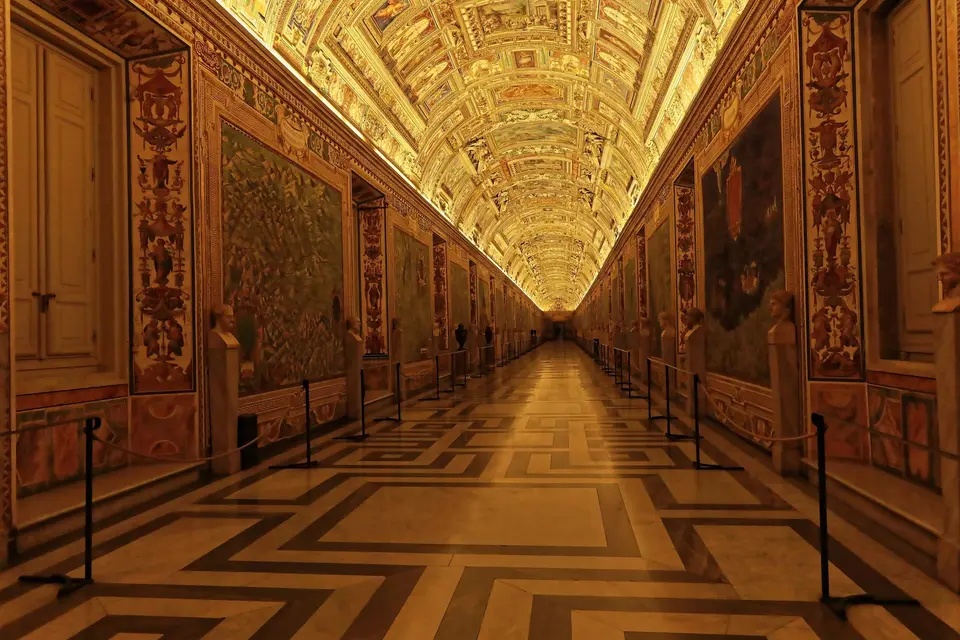
This is the corridor that turns up in almost every photo of the museums, and the numbers behind it are better than the picture. It is 120 metres long and 6 wide, with 40 painted maps of Italy on its walls. Ottaviano Mascherino built it between 1578 and 1580, it was painted in under two years under Girolamo Muziano and Cesare Nebbia, and Egnazio Danti devised the scheme. The gilded vault is divided into 51 panels.
Don’t walk the whole length staring at the ceiling. Pick out an Italian city you know on the maps. That’s the whole point of the room.
The best order to see it in
I wouldn’t improvise a route on a first visit. The official guided tours follow a sequence that works, and the last-Sunday tour sums it up neatly. It starts in the Pinacoteca, moves to the Pio Clementino and its Octagonal Court, then through the Galleries of the Candelabra, Maps and Tapestries, on to the Raphael Rooms and finally the Sistine Chapel.
That takes you from painting to ancient sculpture, then along the upper galleries to Raphael and Michelangelo. If you still have energy, the Egyptian and Etruscan museums are the best extras. The official guided tour costs €40 full price or €30 reduced, entry included, and the official audio guide is €8 in twelve languages. Every way in is compared on the Vatican tickets page.
How long does it take?
There’s no official figure for a self-guided visit, but the museums’ own tours are a fair yardstick. The standard guided tour lasts about two hours, the Arte e Fede tour an hour and a half and the last-Sunday tour about three. The combined tour with the Vatican Gardens also runs to roughly three hours. I wouldn’t plan on less than the guided tour takes, and I’d allow more if you want Egypt and the Etruscans.
The real limit is last entry. The museums open from 08:00 to 20:00, Monday to Saturday, but the doors close to new visitors at 18:00 and staff begin clearing the rooms half an hour before closing. Book one of the last afternoon slots and you’ll have two hours or less. Online slots are released every half hour from 08:00.
Two spiral staircases
People often mix up the two. The one you’ll have seen in countless photos is the double-helix staircase usually credited to Giuseppe Momo. The museums don’t publish a page about it, so I won’t give you a date I can’t stand behind.
The other is Bramante’s Staircase, which you can see from the Etruscan Museum but can’t use on a normal ticket. It only opens as part of the special openings of closed areas, which cost €300 for a group of up to ten, plus each person’s ticket.
Getting in and the practical bits
The entrance is on Viale Vaticano, with the metro at Ottaviano or Cipro (line A) and bus 49 stopping on the forecourt. The cloakroom is free, and you’ll be asked to leave suitcases, rucksacks and bulky bags the staff consider unsuitable, as well as medium or pointed umbrellas, tripods and alcohol. If you’re heading on to St Peter’s Basilica, the museums advise against leaving luggage in their cloakroom. There is no wifi anywhere inside, and air conditioning is limited in some areas, especially in summer.
Personal photos are fine everywhere except the Sistine Chapel, never with flash or a selfie stick. Most of the museum is accessible, wheelchairs can be borrowed free of charge at the cloakroom and there is a barrier-free itinerary with help from the attendants. The dress code and the rest of the rules are on the how to visit the Vatican page.
Vatican Museums opening hours (2026)
| Day | Hours | Last entry |
|---|---|---|
| Monday to Saturday | 08:00-20:00 | 18:00 |
| Last Sunday of the month | 09:00-14:00, free | 12:30 |
| Other Sundays | Closed | No entry |
| 24 and 31 December 2026 | Closes at 15:00 | 13:00 |
Fixed closures each year are 1 and 6 January, 11 February, 19 March, Easter Monday, 1 May, 29 June, 14 and 15 August and 8, 25 and 26 December. Online slots run every 30 minutes, from 08:00 to 17:30 on a weekday.
Tickets and official tours
| Option | Full price | Reduced | Length |
|---|---|---|---|
| Ticket at the door | €20 | €10 | Self-guided |
| Ticket booked online | €25 | €15 | Self-guided |
| Official guided tour, Museums | €40 | €30 | About 2 hours |
| Guided tour, Arte e Fede | €40 | €30 | 1 hour 30 |
| Guided tour, Gardens and Museums | €45 | €35 | About 3 hours |
| Audio guide (optional) | €8 | €8 | Self-guided |
Reduced tickets are for ages 7 to 18 and students up to 25 with a valid card. Under-7s go free. The only official online shop is tickets.museivaticani.va.
Frequently asked questions
How long do you need at the Vatican Museums?
The full route runs to 7 kilometres, so nobody sees it all in one visit. The official guided tour of the highlights takes about two hours, and the last-Sunday tour, which takes in the Pinacoteca, the upper galleries, the Raphael Rooms and the Sistine Chapel, about three. With last entry at 18:00 and closing at 20:00, a late slot leaves you two hours at most.
Does a Vatican Museums ticket include the Sistine Chapel?
Yes. The standard ticket covers the museums and the Sistine Chapel on the day it was issued. The chapel is part of the route, and the official guided tours finish there.
What are the Vatican Museums opening hours?
Monday to Saturday from 08:00 to 20:00, with last entry at 18:00. They are closed on Sundays except the last Sunday of the month, when entry is free from 09:00 to 14:00 (last entry 12:30).
How much is a Vatican Museums ticket?
A full-price ticket is €20 at the door and €25 online, because the official site adds a €5 booking fee. Reduced tickets cost €10 or €15, children under seven go free, and entry is free on the last Sunday of every month.
What is the dress code for the Vatican Museums?
No sleeveless or low-cut tops, no shorts above the knee, no miniskirts and no hats. The same rule applies in the Sistine Chapel, St Peter's Basilica and the Vatican Gardens.
Where is the entrance to the Vatican Museums?
On Viale Vaticano. If you've booked, use the reserved queue to the right of the main entrance. The nearest metro stops are Ottaviano and Cipro on line A, and bus 49 stops on the forecourt outside.
Can you take photos in the Vatican Museums?
Yes, for personal use and without flash, everywhere except the Sistine Chapel, where photos are banned. Tripods, drones, professional kit and selfie sticks are not allowed.

By
Tourism graduate with a master’s in Tourism Management and Planning from the University of Málaga, who has travelled across Europe. He writes every guide from official sources and his own judgement.
Published on .