Inside the Vatican Museums
The Sistine Chapel, from Botticelli's walls to Michelangelo's ceiling
The Sistine Chapel sits inside the Vatican Museums and you reach it on a museum ticket (€20 at the ticket office, €25 booked online). Michelangelo painted the ceiling between 1508 and 1512 and the Last Judgement between 1536 and 1541, while the walls date from 1481-1482. Photos, filming and phones are not allowed inside.
Where the Sistine Chapel is and how you get in
The chapel is inside Vatican City, but there is no separate visitors’ door. You reach it as part of the Vatican Museums, through the entrance on Viale Vaticano, and the same ticket covers both on the day it was issued. Full price is €20 at the ticket office or €25 online, where a €5 booking fee is added. Reduced tickets are €10 or €15, and children under seven go free. If you have booked, use the reserved queue to the right of the main entrance.
The official guided tours save the chapel for last, after the Pinacoteca, the Pio Clementino, the three galleries named after the Candelabra, the Maps and the Tapestries, and the Raphael Rooms. Expect to arrive with a few hours of walking already in your legs. Doors open at 08:00 and close at 20:00 from Monday to Saturday, the last visitors are let in at 18:00, and attendants start moving people towards the exits thirty minutes before closing. Enter on a late slot, linger over Raphael, and you may reach the chapel just as you’re being ushered out.
Every way in, from standard tickets to the official guided tours, is compared on the Vatican tickets page. One warning from the museums themselves is worth repeating here. The only official online shop is tickets.museivaticani.va, and several lookalike domains charge noticeably more.
Who painted the Sistine Chapel, and when
The short answer is Michelangelo, but the building is older than his work. It takes its name from Pope Sixtus IV della Rovere, who rebuilt the old Cappella Magna between 1477 and 1480 and consecrated it to the Assumption on 15 August 1483. For the walls he hired Perugino, Botticelli, Ghirlandaio and Cosimo Rosselli, helped by Luca Signorelli, Biagio di Antonio and Bartolomeo della Gatta, who worked there in 1481 and 1482. The original ceiling was a starry sky by Pier Matteo d’Amelia.
Michelangelo came in twice, a generation apart. He signed the contract for the ceiling on 8 May 1508, finished the first half in August 1510 and completed it in October 1512. Julius II celebrated Mass beneath it on 1 November 1512. The Last Judgement was a separate commission from Clement VII at the end of 1533, painted from 1536, under Paul III, until the autumn of 1541.
Reading the ceiling before you go
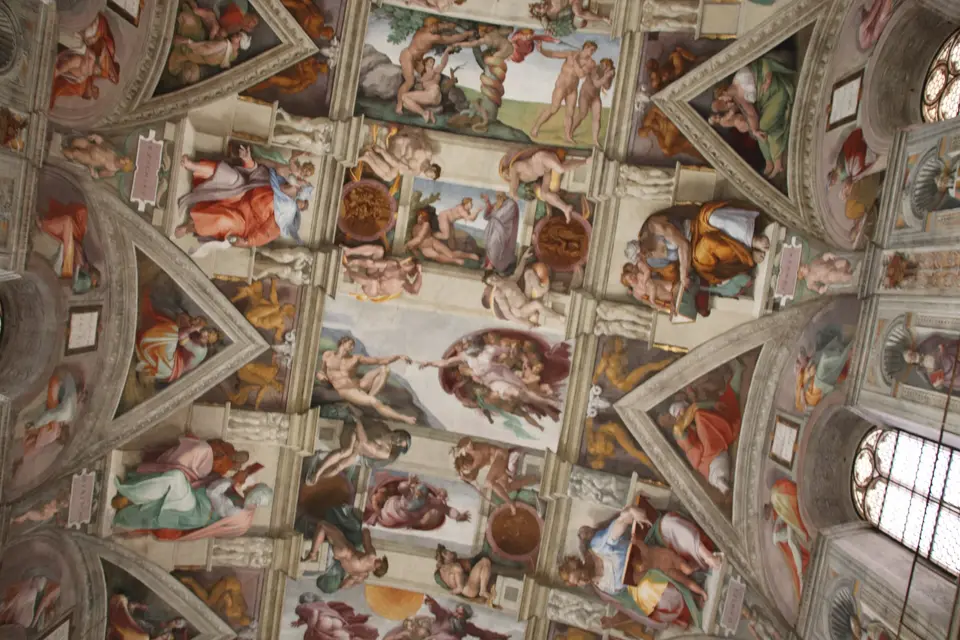
Size is the first thing to take in. The official measurements put the chapel at roughly 40 metres long, 13 wide and almost 21 high, and the ceiling spans all of it. Trying to read it in one sweep rarely works, so break it up.
Along the centre run nine scenes from Genesis, including The Creation of Adam, which is where most people look first and a handy anchor for finding your bearings. Around them are five Sibyls and seven Prophets. I’d take it in three passes. Find the Creation of Adam, follow the nine scenes along the length of the chapel, then give the Sibyls and Prophets some time of their own, as they tend to be overlooked.
The colours you see are the result of a full restoration of the frescoes that ran from 1979 to 1999.
The Last Judgement on the altar wall
The Last Judgement came at a cost. Frescoes by Perugino that were part of the fifteenth-century scheme were lost to make room for it. In 1564 the decision was taken to cover the nudes, and the draperies were painted by Daniele da Volterra. Restoration of this wall finished in 1994, marked by a Mass celebrated by John Paul II on 8 April.
I’d leave it until after the ceiling and look at it head-on, without rushing. It is a single scene rather than a sequence of panels, so it rewards standing still.
The fifteenth-century walls most people walk past
The walls are the oldest painting in the room and get the least attention. They hold the Stories of Moses and of Christ, a series of papal portraits and painted curtains that imitate fabric. This is the scheme Sixtus IV paid for, signed off by some of the best-known names of the century. By the time Michelangelo signed his contract in 1508, these frescoes had been there for more than a quarter of a century.
No photos, no phones
You can take photos for personal use across the rest of the museums, without flash. The chapel is different. Photos and filming on any device are banned, phones can’t be used, and complete silence is requested. Attendants can ask you to delete anything you’ve recorded. Accredited guides are not allowed to talk or explain inside either, which is why groups get their briefing before they walk in.
In practice that means you can’t look anything up while you’re standing under the ceiling, which is the reason the two sections above are worth reading on the way. The dress code applies here too, so no sleeveless or low-cut tops, shorts above the knee, miniskirts or hats. The rest of the visitor rules are covered in how to visit the Vatican.
Conclaves and the 2026 clean
The Sistine Chapel has been the permanent venue for conclaves since 1878. The latest elected Robert Francis Prevost as Leo XIV on 8 May 2025. According to the Italian news agency ANSA, that conclave opened on 7 May and the chapel closed to the public from 28 April to prepare. If you’d like to see the Pope himself, audiences and Masses are covered on how to see the Pope.
From 1 February to 27 March 2026 the Last Judgement underwent extraordinary maintenance to remove a whitish film of calcium lactate, which the museums link to lactic acid in visitors’ perspiration. The chapel stayed open throughout, behind a canvas cover reproducing the fresco, and the wall is now back on view.
When you leave, bear in mind that the museums’ official website doesn’t mention any direct route from the chapel to St Peter’s Basilica, so plan on using the normal museum exit.
Vatican Museums and Sistine Chapel opening hours (2026)
| Day | Hours | Last entry |
|---|---|---|
| Monday to Saturday | 08:00-20:00 | 18:00 |
| Last Sunday of the month | 09:00-14:00, free | 12:30 |
| Other Sundays | Closed | No entry |
| 24 and 31 December 2026 | Closes at 15:00 | 13:00 |
For the rest of 2026 the museums also close on 8, 25 and 26 December. The remaining free last Sundays are 27 September, 25 October, 29 November and 27 December. Rooms start clearing 30 minutes before closing time.
Ticket prices (Vatican Museums and Sistine Chapel)
| Ticket | At the ticket office | Online, with booking |
|---|---|---|
| Full price | €20 | €25 |
| Reduced (ages 7 to 18, students up to 25) | €10 | €15 |
| Children under 7 | Free | Free |
| Last Sunday of the month | Free | Optional official guided tour, €20 |
The only official online shop is tickets.museivaticani.va. Tickets are valid only on the date issued and are non-refundable.
Frequently asked questions
Who painted the Sistine Chapel?
Michelangelo painted the ceiling (1508-1512) and the Last Judgement on the altar wall (1536-1541). The walls are older, from 1481-1482, and were painted by a team led by Perugino, Botticelli, Ghirlandaio and Cosimo Rosselli, with Luca Signorelli among their assistants.
How long did it take Michelangelo to paint the Sistine Chapel ceiling?
A little over four years. He signed the contract on 8 May 1508, finished the first half in August 1510 and completed the ceiling in October 1512. Pope Julius II unveiled it with a Mass on 1 November 1512.
Can you take photos in the Sistine Chapel?
No. Vatican Museums rules ban photos and video on any device inside the chapel, and attendants can ask you to delete them on the spot. Phones can't be used at all and silence is expected. Everywhere else in the museums you can take photos for personal use, without flash.
Where is the Sistine Chapel?
It is inside Vatican City, at the end of the Vatican Museums route. You go in through the museums' entrance on Viale Vaticano, and the nearest metro stops are Ottaviano and Cipro on line A.
Can you go to the Sistine Chapel without booking?
Yes. A full-price ticket costs €20 at the ticket office without a booking, and it covers the museums and the chapel. Booking online on the official site adds a €5 fee but lets you use the reserved queue on the right of the main entrance.
What are the Sistine Chapel opening hours?
The chapel keeps the Vatican Museums' hours, Monday to Saturday from 08:00 to 20:00 with last entry at 18:00. It is closed on Sundays except the last Sunday of the month, when entry is free from 09:00 to 14:00 (last entry 12:30).

By
Tourism graduate with a master’s in Tourism Management and Planning from the University of Málaga, who has travelled across Europe. He writes every guide from official sources and his own judgement.
Published on .