The Scavi tour, by request and with a guide
The Vatican Necropolis and St Peter's tomb
The Vatican Necropolis, beneath St Peter's Basilica, can only be seen on a guided tour booked in advance. In 2026 you request it through a form on the basilica's official tours website, not by email, and it costs €20 (€14 for ages 10 to 17). Groups are capped at 12, the tour lasts an hour and under-10s are not admitted.
Under St Peter’s Basilica runs a Roman street of tombs that Constantine buried to make room for his church, and at the far end of it is the grave the Church identifies as the apostle’s. You can walk it, but on strict terms. Around 250 people a day, in groups of twelve, with a guide and a booking made in advance. It is the one Vatican visit worth arranging before anything else on your trip.
How booking works now
The booking process has changed, and plenty of guides still describe the old one. Today you apply through a form on the basilica’s official tours website. You enter the number of people, the language and your preferred date and time, but the site itself warns that the date and time are purely indicative and not guaranteed. The office allocates a slot based on availability and then emails you a link to pay by card.
The old website of the Excavations Office (the Ufficio Scavi) still describes the previous method, by email, fax or in person. It isn’t confirmed that requests sent that way are still handled, and that site’s home page now returns an error, so I would use the new form only. If you need to correct something after booking, the Fabbrica’s guided tours address is visiteguidate@fsp.va.
There is no minimum notice period. The official wording is simply that booking in advance is compulsory because daily availability is limited. With around 250 places a day for the whole world, the earlier you ask, the better your chances of a date that fits.
Price, age limit and group size
In 2026 a ticket costs €20, or €14 for 10- to 17-year-olds. Both include an authorised guide, because there is no independent entry and no audio guide. Payment is by credit card only. The €13 flat price still quoted on older pages is out of date.
The minimum age is 10, with no exceptions. Groups hold up to 12 people and leave every 15 minutes, from 9am to 4.30pm on weekdays and on Saturday mornings. The necropolis is closed on Sundays and Vatican holidays. Tours run in Italian, English, Spanish, French, German, Portuguese, Dutch, Polish, Hungarian and Japanese, and the form also lists Italian Sign Language and Ukrainian.
On the day
Be at the Excavations Office 10 minutes before your slot. The only way in is the Via Paolo VI entrance, on the left-hand side of the colonnade, through the entrance to the Audience Hall. It is not the security check in St Peter’s Square that everyone else uses for the basilica. Latecomers can lose their place.
The rules are strict. No photos or video, no rucksacks or large bags, and no food, though a small bottle of water is allowed in summer. Shoulders and knees must be covered. Down below the humidity is around 98 %, there are steps and the ancient floor is uneven, so the official site advises against the tour for anyone with claustrophobia or physical difficulties and states that it is not accessible to visitors with disabilities. Tickets are non-refundable.
What you see below the basilica
The necropolis lies beneath the Vatican Grottoes, between 3 and 11 metres below the floor of the nave. It was uncovered by excavations ordered by Pius XII, which the official site dates to 1939 to 1949.
The route follows an old beaten-earth path lined by 22 funerary buildings designed for around a thousand burials. To build his basilica, Constantine filled in the whole area by moving more than 40,000 cubic metres of earth, and the necropolis ended up under that infill.
The tour finishes at Peter’s tomb. According to the Fabbrica di San Pietro it was a simple grave on the southern slope of the Vatican hill, facing Nero’s circus. In the second century a small shrine, known as the Trophy of Gaius, was built above it against a wall called the red wall. On a nearby wall, wall G, Latin graffiti carry the names of Christ and Peter.
‘Peter is here’
The most quoted find is a fragment of plaster from the red wall measuring just 3.2 by 5.8 centimetres. Scratched into it are the incomplete letters PETR and ENI. They are read either as ‘Pétros enì’, Peter is here, or ‘Pétros en irène’, Peter in peace. The official site gives both readings.
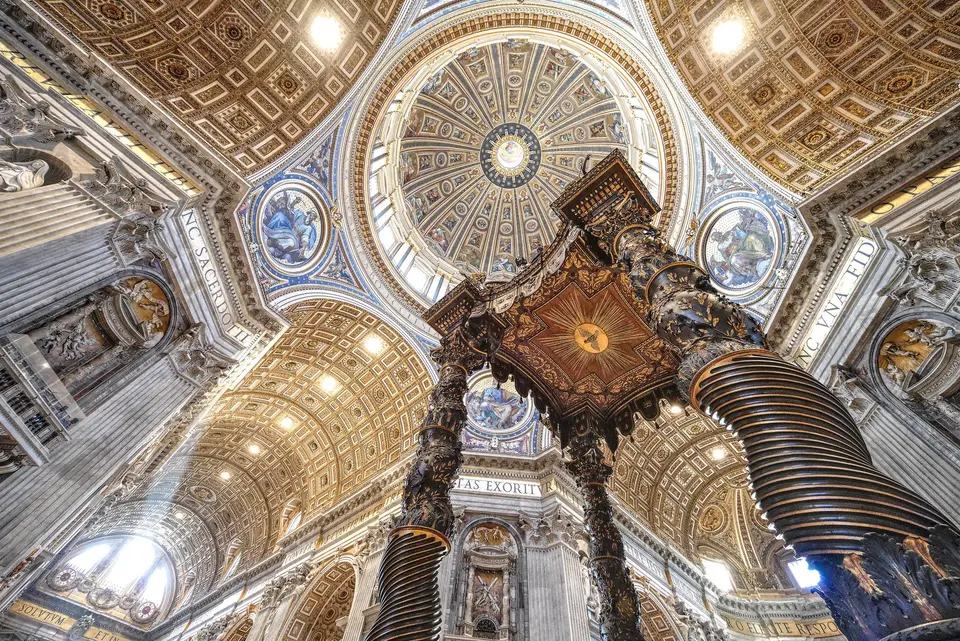
The immersive exhibition that the basilica opened in its Octagonal Rooms borrows the same name. It also helps to picture how the building is stacked above this spot. Over the tomb is the Niche of the Pallia, which corresponds to the second-century shrine, and above that the papal altar under Bernini’s baldacchino. I go through what to see up there in my guide to St Peter’s Basilica.
No place? Try the Grottoes
The Vatican Grottoes sit between the necropolis and the basilica, and they are a different kind of visit. Entry is free, with no booking, every day from 9am to 6pm, though guided tours and photography are not allowed. Pius XII and Benedict XVI are buried here, and since 1979 a central arch has given a view of the front of the Confession.
They are no substitute for the necropolis, but they are the best fallback. To plan the rest of your day around a fixed Scavi slot, my Vatican tickets guide compares the ways in, and the practical guide to visiting the Vatican covers the rest.
Scavi tour prices in 2026
| Ticket | Price | Conditions |
|---|---|---|
| Full price | €20 | With an authorised guide |
| Reduced | €14 | Ages 10 to 17, with an authorised guide |
| Under 10 | Not admitted | Minimum age is 10 |
Prices from the official booking page, checked on 24-09-2026. Payment is by credit card only, through the link the office emails you, and tickets are non-refundable.
Tour times
| Days | Hours | Last tour |
|---|---|---|
| Monday to Friday | 9:00 to 16:30 | 16:15 |
| Saturday | 9:00 to 13:00 | 12:15 |
| Sundays and Vatican holidays | Closed | No tours |
Closures still to come in 2026, according to the official site: 1 and 2 November, and 8, 24, 25, 26, 27 and 31 December.
Frequently asked questions
How do you book the Scavi tour?
Through the request form on the official tours website of St Peter's Basilica. You give a preferred date and time, which are only indicative, the office assigns you a slot and then emails you a link to pay by card. The old method of writing to the Excavations Office by email or fax is no longer the current route.
How much does the Scavi tour cost?
In 2026 it costs €20, or €14 for young people aged 10 to 17, with an authorised guide included. Payment is by credit card only. The €13 price you may still see comes from an old page and is out of date.
How long is the Vatican Necropolis tour?
One hour. Groups of up to 12 set off every 15 minutes, and you need to be at the Excavations Office 10 minutes before your slot.
How far in advance should I book the Scavi tour?
There is no fixed deadline, but booking ahead is compulsory because daily places are limited to around 250. I would request it as soon as your dates are set and offer several possible days.
What do you see on the Scavi tour?
You walk along an ancient Roman street of tombs, lined with 22 funerary buildings, 3 to 11 metres below the basilica floor. The route ends at the tomb the Church identifies as St Peter's, with the second-century shrine above it and walls carrying Latin graffiti.
Is the Scavi tour suitable for children?
Only from age 10; younger children are not admitted. Bear in mind the humidity of around 98 %, the steps and the uneven ancient floor, which also make the tour unsuitable for wheelchair users.
What is the dress code for the Scavi tour?
Shoulders and knees covered. Large bags and rucksacks are not allowed, and neither is food, though a small bottle of water is permitted in summer. Photos and video are banned throughout.

By
Tourism graduate with a master’s in Tourism Management and Planning from the University of Málaga, who has travelled across Europe. He writes every guide from official sources and his own judgement.
Published on .