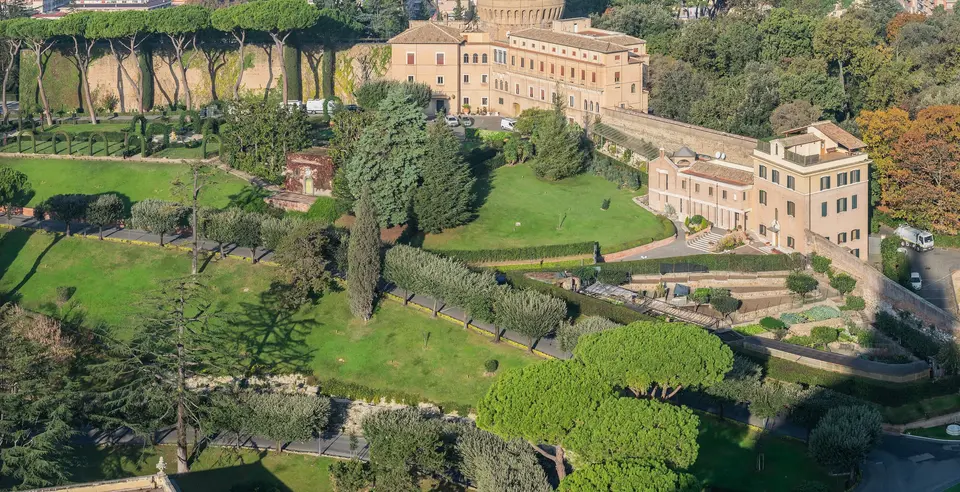
Holy See property on Italian soil
Castel Gandolfo, the papal summer retreat
Castel Gandolfo is an Italian hill town a few kilometres from Rome, above Lake Albano, where the Holy See owns 55 hectares with extraterritorial status. It is not part of Vatican City. Popes have summered there since 1626, and the official Vatican Museums calendar shows the Papal Palace open to visitors in 2026 on every day except Tuesdays.
Castel Gandolfo turns up in almost every search about the Vatican because it’s where the Pope spends his summers, yet it isn’t in Vatican City at all. It’s an Italian town a few kilometres outside Rome, above Lake Albano, where the Holy See owns a palace, several villas and their gardens. I’ve included it in this guide because that’s how travellers look for it, and because both its legal status and its 2026 opening days cause a fair bit of confusion.
An Italian town with a papal estate
Vatican City covers 0.44 km² and stops at its walls and at the strip of travertine across St Peter’s Square. Castel Gandolfo lies well outside that. What the Holy See holds there is an extraterritorial property on Italian soil, recognised in the Lateran Pacts of 1929.
Article 14 of the Treaty gives the Holy See full ownership of the papal palace at Castel Gandolfo with everything attached to it, and hands over the Villa Barberini as well. The articles that follow grant those properties immunities and exempt them from expropriation and taxes. In practice it behaves like a piece of the Holy See inside Italy, much like the major papal basilicas in Rome, but legally it remains Italy. The extraterritorial area comes to 55 hectares, of which about 30 are villas and gardens. For the difference between the state and these outlying properties, our Vatican City guide goes into more detail.
How the popes came to summer here
The papacy bought the estate in 1596, under Clement VIII. The first Pope to spend a summer there was Urban VIII, in 1626, and it became the popes’ summer residence from then on. The Vatican Observatory moved there in 1934, and Pius XII died in the palace on 9 October 1958.
Three residences sit within the estate. There’s the Apostolic Palace on the town square, the Villa Cybo, and the Villa Barberini with its gardens. The palace is the part you can visit, and Piazza della Libertà in front of it is the heart of the town.
Leo XIV brings the summer stay back
For twelve years no Pope took his summer holiday at Castel Gandolfo. Leo XIV revived the tradition in 2025, staying from 6 to 20 July and again from 15 to 17 August. That year he lodged at the Villa Barberini rather than the palace, and led the Angelus in Piazza della Libertà.
He was back from Sunday 5 to Monday 27 July 2026. The official statement refers to the Apostolic Palace of Castel Gandolfo without naming the exact building. There were no audiences in the Vatican during those weeks, and the Sunday Angelus on 12, 19 and 26 July was held in the town square. If you want to see the Pope in summer, this is where to go, and our page on seeing the Pope covers the rest of the year.
Press reports add that since autumn 2025 the Pope has gone up to Castel Gandolfo almost every week, arriving on Monday evening and leaving on Tuesday evening. That lines up with the palace being closed to visitors on Tuesdays, although the official site doesn’t give a reason.
Is the palace open to visitors in 2026?
This is the question that has come up most in 2026. On 22 October 2016, at Pope Francis’s wish, the private papal apartment in the palace was opened to the public, including the bedroom, private chapel, library and study. In spring 2026 several outlets reported that the palace would stop operating as a museum from 1 July and revert to being purely a papal residence. I couldn’t find any official statement saying so.
What the Vatican Museums website does publish is the official 2026 calendar for the visit, which goes by the name Palazzo Papale e Giardino Segreto. Updated in September, it marks the whole of July as closed, when the Pope was in residence, and shows opening days from August through to December, closed every Tuesday. You’ll find the times in the table on this page. My reading is that the palace is still opening as a museum on the days shown, but things have moved quickly during 2026, so I’d check the calendar the day before.
The official reduced prices are €6 (ages 7 to 18, students up to 25, clergy and pilgrim groups), €5 for school groups and free for under-6s. I haven’t given the full adult price because the official site doesn’t show it clearly for this visit. Official sales go through the same system as the Vatican Museums, and our Vatican tickets guide has prices for everything else.
Getting there by train from Rome
You don’t need a car. Trenitalia’s FL4 regional line leaves from Roma Termini, and trains on the branch to Albano stop at Castel Gandolfo station. Ticket comparison sites put the journey at around 40 minutes for a distance of roughly 20 km.
One thing worth knowing before you set off is that the station sits below the town centre, so there’s an uphill walk to Piazza della Libertà when you arrive. With small children or in the heat, build that into your timings.
I’d treat it as a half-day trip, taking a morning train out, visiting the palace before it shuts (14:30 on weekdays) and keeping the afternoon for the town or the journey back to Rome. If you’d rather not be tied to the last train, the Booking box on this page searches for places to stay in Castel Gandolfo itself.
Papal Palace opening times (August to December 2026)
| Days | First and last admission | Closes |
|---|---|---|
| Monday, Wednesday, Thursday and Friday | 9:00 to 13:00 | 14:30 |
| Tuesday | Closed | Closed |
| Saturdays, August to October | 9:00 to 17:00 | 18:30 |
| Saturdays, November and December | 9:00 to 16:00 | 17:30 |
| Sundays | 10:00 to 17:00 | 18:30 |
Official Vatican Museums calendar for 2026, updated in September. Also closed on 1 November and on 25 and 26 December, and closed throughout July. Visitors are asked to leave the rooms from 30 minutes before closing.
Published reduced tickets
| Who | Price |
|---|---|
| Ages 7 to 18, students up to 25, clergy and pilgrim groups | €6 |
| School groups | €5 |
| Under-6s | Free |
Official prices for the Palazzo Papale e Giardino Segreto visit. I couldn't confirm the full adult price on the official site as of 24 September 2026, so I haven't given one.
Frequently asked questions
Can you visit Castel Gandolfo?
Yes, according to the official Vatican Museums calendar updated in September 2026. The Papal Palace was closed for all of July while the Pope was in residence, and from August to December it opens every day except Tuesdays and a few holidays. There were press reports of a permanent closure that the official site has not borne out, so check the calendar before you go.
Is Castel Gandolfo part of Vatican City?
No. Vatican City covers 0.44 km² and ends at its walls. Castel Gandolfo is property of the Holy See on Italian soil, with immunities granted by the 1929 Lateran Treaty, but it is not part of the state's territory.
How far is Castel Gandolfo from Rome?
Roughly 20 km. Ticket comparison sites put the train journey from Roma Termini at around 40 minutes. The Vatican's own site simply describes it as a few kilometres from Rome.
How do you get from Rome to Castel Gandolfo?
By regional train from Roma Termini on Trenitalia's FL4 line, taking a service on the branch to Albano, which stops at Castel Gandolfo. The station sits below the town centre, so allow time for the walk uphill to Piazza della Libertà.
What is there to see in Castel Gandolfo?
The main sight is the official visit to the Papal Palace and its Secret Garden. The private papal apartment, with its bedroom, chapel, library and study, was first opened to the public in 2016. The palace faces Piazza della Libertà, where the Pope leads the Angelus on Sundays he spends there.
Does the Pope live at Castel Gandolfo?
Only part of the time. Leo XIV revived the papal summer stay there in 2025, after twelve years without one, and returned from 5 to 27 July 2026. Press reports say he also tends to spend Monday evening to Tuesday evening there most weeks. His residence remains in the Vatican.

By
Tourism graduate with a master’s in Tourism Management and Planning from the University of Málaga, who has travelled across Europe. He writes every guide from official sources and his own judgement.
Published on .